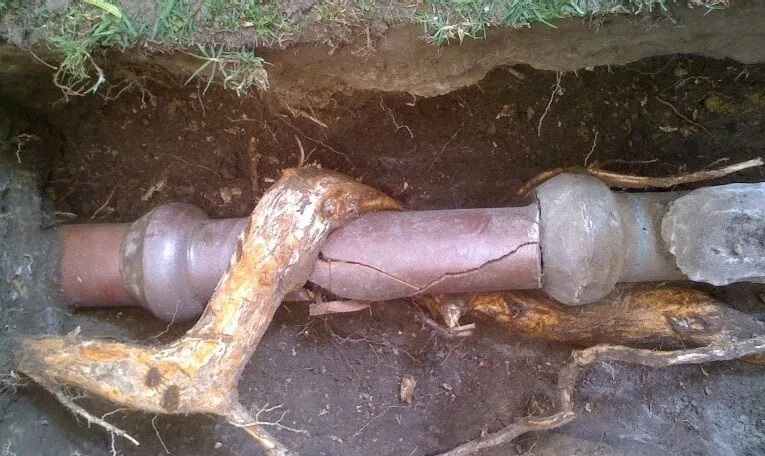
When tree roots invade your main sewer line — or a stubborn blockage shrugs off everything else — that's rooter territory. A rooter machine drives a heavy-duty cutting head through the line, slicing through root masses and compacted buildup that ordinary snakes can't handle. We run rooter service across Pueblo and Pueblo West, where mature trees and aging clay pipe make root intrusion one of the most common sewer problems around.
A rooter is a heavy-duty drain machine built for the main sewer line. Where a drain snake uses a flexible cable for fixture drains, a rooter drives a thicker, more powerful cable fitted with interchangeable cutting heads — spiral blades and root saws designed to chew through tree roots, compacted scale, and dense blockages deep in the line.
The term goes back to the original Rooter machine, but today it describes a category of professional equipment sized for 3- to 6-inch main lines. The operator feeds the cable through a cleanout access, and the rotating cutter head clears the full diameter of the pipe rather than just poking a hole through the clog. For root intrusion especially, that full-diameter clearing is what restores real flow.
Rooter service is a clearing method, not a structural fix: it removes what's blocking the pipe. If the camera shows the pipe itself is broken or collapsed, we'll show you the footage and talk honestly about repair or replacement options instead of selling you another clearing.
Rooter service is for main-line problems — when the issue is bigger than a single slow drain.
Toilet, tub, and sinks acting up together points to the main line, not a fixture drain. That's rooter territory.
If the main line has needed clearing before and it's slow again, roots or buildup have likely reclaimed the pipe.
Widespread gurgling means air is trapped by a restriction deep in the line — a classic sign of root intrusion.
Backups at tubs, showers, or floor drains are the lowest points in the system — and the first to show a main-line blockage.
If a past cleaning pulled roots out of your line, they'll grow back. Scheduled rooter service keeps them from taking over again.
Suspiciously green strips of grass above the sewer line can mean roots have found a nutrient-rich leak to exploit.
They're related tools for different jobs. Here's the practical difference.
Drain snaking uses a lighter, flexible cable sized for fixture drains — sinks, tubs, showers, toilets. It's the right call for a clog close to the fixture. Rooter service uses a heavier machine with root-cutting heads sized for the main sewer line, typically 3 to 6 inches in diameter. When the blockage is roots, compacted scale, or a dense main-line obstruction, a snake often just pokes through and the problem returns within weeks — a rooter clears the full pipe diameter.
Rule of thumb we give Pueblo homeowners: one slow fixture, start with drain snaking. Whole-house symptoms or known root history, go straight to rooter service — it saves paying for the wrong tool first.
Ask any longtime Pueblo plumber about the most common main-line failure and you'll hear the same answer: roots.
Much of Pueblo's housing stock sits on clay tile or aging cast-iron sewer lines — pipe with joints every few feet. Tree roots naturally seek moisture, and a tiny joint gap is all they need. Once inside, roots thrive in the nutrient-rich flow and expand year after year, eventually filling the pipe or breaking joints apart. Mature, tree-lined streets in the older neighborhoods and the clay soils toward Pueblo West make this a local pattern, not bad luck.
Here's the part most homeowners learn the hard way: cutting roots doesn't close the entry points. That's why rooter service is often a maintenance rhythm — typically every 12 to 24 months for root-prone lines — rather than a one-time fix. When the camera shows the pipe itself is failing, we'll tell you honestly that it's time to talk replacement instead of another clearing.
No guesswork, no mess left behind — here's exactly what happens when we roll up.
We start with what's happening in the house — which fixtures, how often, and what's been tried — to confirm we're dealing with a main-line issue.
We work through your sewer cleanout whenever one exists — it's the proper access point and keeps the work outside your living space. No cleanout? We'll discuss adding one; it's one of the best investments for any home with root history.
The rooter cable goes in with the right cutting head for what we're facing — root saws for intrusion, spiral blades for compacted buildup — clearing the full diameter of the pipe.
We flush the line and run water through multiple fixtures to confirm full flow is restored — then camera-verify on request so you can see the cleared pipe yourself.
You'll get a straight read on the pipe's condition and whether a maintenance schedule, a hydro jetting follow-up, or eventual replacement makes the most sense.
We quote from what we find, not from a script. These are the factors that set the price.
A light root touch-up costs less than a line packed solid with a decade of root mass. We'll tell you which one you're looking at.
A proper exterior cleanout makes the job faster and cheaper. Pulling a toilet for access adds labor — another reason a cleanout installation pays for itself.
Longer runs and lines with offsets or damage take more time and care to clear safely without harming the pipe.
Optional but recommended: seeing the cleared line on camera confirms the job and documents the pipe's condition for future decisions.
One firm price before we start — call 719-280-6619 for a free assessment and upfront quote.
We size the machine and cutting head to your line — enough power to clear roots fully, not so much that it risks the pipe.
Don't take our word for it — watch the camera run through your cleared line and see the result yourself.
If the camera shows a collapsed or broken pipe, we'll say so plainly instead of selling repeat clearings that can't fix it.
You approve one firm price before the machine ever comes off the truck. No hourly meters running.
For lines with chronic root intrusion, we'll lay out a sensible maintenance rhythm so you're never surprised by a backup again.
We know which Pueblo neighborhoods and pipe materials are root magnets — and plan the work accordingly.
Sewage backing up, toilet that won't flush, kitchen sink overflowing before a dinner party — call us. We dispatch same-day for emergencies throughout Pueblo and Pueblo West.
The questions we hear most often from Pueblo homeowners before booking rooter service.
Short reads that cover what we explain on job sites every week.
Snakes clear fixture drains. Rooters cut through main-line roots and heavy blockages. Hydro jetting scours the whole pipe clean with high-pressure water. The right choice depends on where the blockage is and what's causing it — whole-house symptoms or known roots point to the rooter; a single slow sink points to the snake; recurring buildup calls for jetting.
Read Guide →For clay or cast-iron lines near mature trees, every 12 to 24 months is typical. The first clearing tells us a lot: light root hair suggests a longer interval, while a packed root mass means staying on schedule. Either way, planned maintenance beats a 2 a.m. backup — and costs less than the emergency version of the same job.
Read Guide →Rooter service clears blockages; it can't fix broken pipe. If the camera shows collapses, severe offsets, or deterioration along the whole run, clearing becomes a subscription you don't want. That's when a frank conversation about repair or full replacement saves real money — we'll show you the footage and let it speak for itself.
Read Guide →Rooter service is one piece of the picture. Here's what else we handle throughout Pueblo County.